
Gentrify My Feed
DAO Me Daddy ... Abundance Agenda x Future of Media Monetization !!!

Table of Goodies:
Sparknote voice note because sometimes reading is hard
The best cities don’t have a center
The Abundance Agenda
We don’t need more creators. We need new neighborhoods.
So, WTF is a DAO?
Why it doesn’t suck (aka why you’re reading this)
So how does one DAO on Substack?
TLDR?
Buy DAO2.5 guide HERE ᵕ̈
The best cities don’t have a center.
I learned that from Eve Babitz years ago. They let you drift between neighborhoods that match your mood.
One night you’re ripping cigs outside a LES bodega with smudged eyeliner, the next morning you’re at a gallery in Chelsea wearing an adorable sundress, casually posting to Instagram pretending you forgot it’s not your ex’s birthday.
Selective memory is a skill us women learn a young age.
Cities aren’t meant to be conquered, they’re there to seduce you.
Romanticize your life.
Each neighborhood is a new crush.
A spicy secret waiting to be known.
I’ve been thinking about homes a lot lately, maybe because I’m looking for one in Hawaii and it’s expensive AF.
Neighborhoods are important to me.
I’ve never been a “location doesn’t matter” girl. I’m more the “dishwasher doesn’t matter” type. (Although now that I’m 30 this ideology seems a bit dated… whatever.)
Like our friends and the people we date, choosing where you live says something reflects not just who you are but who you want to be.
Where I am is who I am.
I moved to L.A. pre-pandemic in 2020.
That city was a fantasy for me, and I never judged it for being fake.
I knew what I was signing up for.
I came for the illusion.
The palm-tree mirage. A vegan Pilates lifestyle that cost more than my college tuition.
You chase something long enough, you start to believe you can afford it. At the least, you get very good at pretending.
But the problem with dreams is that, in today’s socioeconomic climate, most people can’t afford them.
Especially when your dream demands a certain zip code.
(Cities like L.A., San Francisco, NYC, etc…)
The rent is high, and the stakes are higher.
For me, the comfort I thought would come always stayed just out of reach.
In 2023, California saw a net loss of 268,000 residents and in New York, 179,000 for states like Florida and Texas.
I was one of them.
Not by choice.
Rent was cannibalizing me and the job market buried my bones.
Now if you know me, you know how much I love Ezra Klein.
Because, Zaddy.
Duh.
And because zaddies don’t sleep, he co-wrote The Abundance Agenda with Derek Thompson, someone I’ve really been enjoying reading lately over at The Atlantic to get a better grasp on the intersection of economics, culture, and media.
I haven’t read it YET (my bad bb), but I started the audiobook on Spotify and have listened to enough press tour soundbites to feel somewhat qualified enough to weigh in with a preliminary POV.
Their take is basically like hey, the housing crisis isn’t just about rent you dopes. It’s about access.
They’re like, people aren’t down bad because we don’t have enough homes, they’re struggling because dope cities make it basically impossible to build more homes where people actually want to live.
Think: Outdated zoning, snail mucin permits, political tantrums, the works.
So now the people with talent and ambition are stuck commuting from the middle of bumble fuck nowhere while cities rot from the inside out.
And, by extension, when you’re priced out of proximity, everything else in your life kinda dominos to shit. Career, relationships, your will to reproduce and star a family… That sort of jazz.
Then Ezra and Derek are like, “Just build more housing, you idiots.”
But not just more-more… more that’s thoughtfully designed to serve actual people and the planet.
Real progressive policy isn’t about squeezing into what’s left. It’s about creating meaningful space with ROI.
For growth.
For belonging.
For whatever comes next.
This whole housing thing fascinates me. Not just because housing is where we sleep or sneakily itch our butts, but because it’s a stand-in for everything we chase life.
Freedom.
Security.
Privacy.
Status.
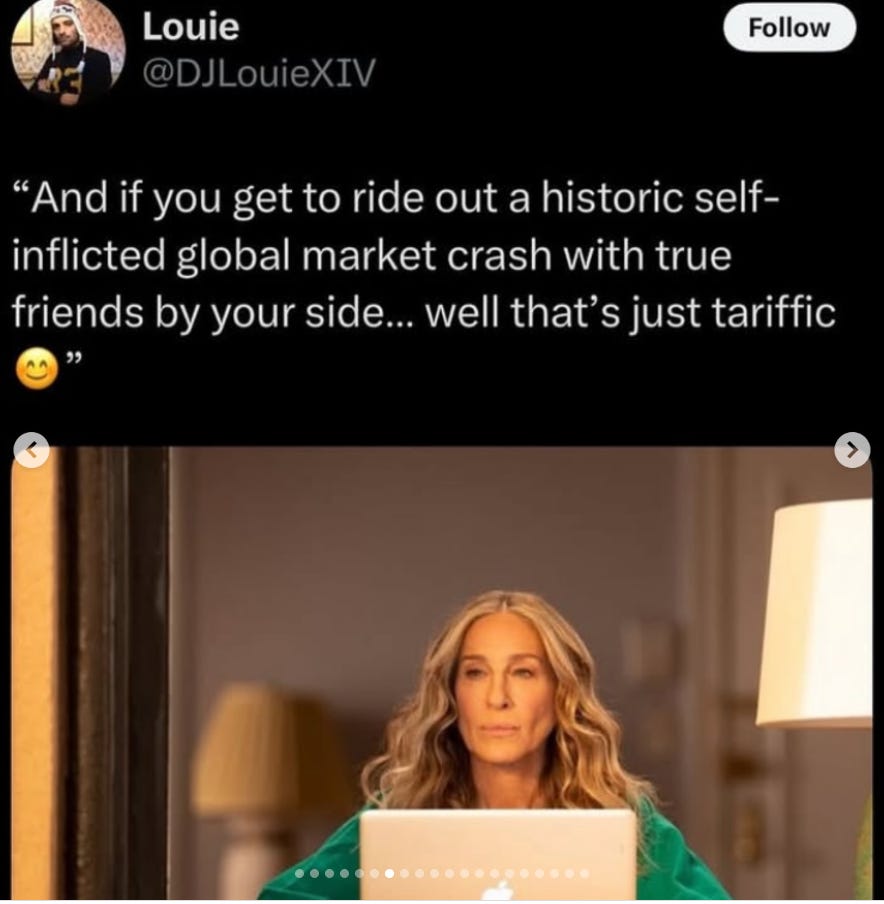
You know, the kinda stuff we claim to care about in debates, but really vote for in minimal square footage while taking a 125% tariff punch to the face every time we turn on the TV. And once you clock that, you start seeing the housing crisis everywhere. Metaphorically, I mean.
It’s not just about square footage, it’s about your favorite $7 oat milk latte at the corner cafe.
The hot yoga studio that’s single-handedly keeping you from replying “per my last email, you dumb stupid bitch” and still keeping your job.
The brands you project your unresolved childhood wounds onto cause we’re all so messed up.
We make homes out of anything that makes us feel held, even if it’s just for five minutes between zoom calls.
This got me thinking about how the housing criss metaphor applies specifically to our media landscape.
How every corner of the internet feels like a construction site... Substack, TikTok, podcasts, “personal brands,” skinny-girl manifestos.
Everyone’s always building something, but nothing feels rooted.
It’s like scrolling through a city with no neighborhoods. Just an endless grid of algorithmic noise, flattened context, and abandoned ideas that couldn’t make rent.
If your feed were a city, it’d be neon chaos: pop-ups screaming for attention, half-baked takes, and Olipop ads hitting like dopamine vampires.
No zoning.
No memory.
No soul.
The way we scroll feels like digital homelessness.
You can’t build community on a billboard.
Maybe abundance isn’t about volume, but about settlement. And maybe that’s what media needs more of too?
Less viral, more vital.
Less content farms, more content homes.
Places people return to. Where rhythm matters.
Not just where you scroll through, but where you stay.
That’s the real flex: retention.
Not clicks.
Not hype.
But gravity.
Stickiness... A place people miss when they're gone.
If I were a brand, I’d stop chasing views. Too fleeting. Outdated even.
I’d prioritize consistency and resonance. Build a scroll proof presence. Because no one can afford to be a small fish in a big ass, scroll-happy sea anymore.
Earned media just doesn’t make a splash like it used to. Brands are dropping millions on “moments” that are forgotten in minutes.
It’s a wash.
The creator economy needs a reset.
Big time.
Less hype machine, more co-op mindset. Less reach, more reinforcement.
We’re not starved for content, we’re malnourished of context.
Of connection.
We’re in a poverty of meaning, desperate for places that feel like something. Like home.
We don’t need more creators. We need new neighborhoods.
The idea that networks are the future of media isn’t new. We’ve seen it with Dear Media, Unwell, even legacy giants like Vogue and The New York Times.
Creators need infrastructure: money, legal backup, reach, marketing muscle. Duh.
So yeah, if I had a Substack following, building a network would be the natural next move.
Momentum wants company.
Substack has that shiny new-platform glow, but you can already feel it pulling from everywhere else.
The great TikTok migration is real.
But what actually interests me isn’t just replicating old models with new fonts. It’s the nuance.
The creator economy below the surface.
A creator led network is like a dinner party: one person plans everything, lights the candles, queues the playlist, plate the grass-fed vegan meat between gluten free buns.
You show up and drink all their wine.
Cool. Same.
Maybe even Venmo them later for the privilege to attend (read: buy a ticket to the Unwell Spring Break tour).
But the whole thing depends on the host’s presence, relevance, and ability to not get canceled for saying something racist in Tulum.
A neighborhood, though? That’s a different story.
It’s democratic.
Built to last.
Imagine an HOA. It has a board of advisors, sure, but everyone gets a vote on whether we’re funding golf carts or a dog park.
Basically, the neighborhood’s coming together to speak their piece and decide how to use the funds to make the place actually work. For everyone.
Less “look at mi tablescape,” more “how do we fund the community garden and stop Bob from parking his scooter on the lawn?”
Or better yet, think of it like a group chat.
One person starts it, but no one owns it.
Someone drops a meme, someone else shares a link to their Sephora discount basket, and three people jump in to offer unsolicited astrological advice to someone in a spiral.
It pops off organically because the right people gathered in the right place. It works because the dynamic works, not because one person is holding court.

Low key this is kinda what Hype House did back in 2020. A bunch of creators sharing a literal house, feeding the algorithm collectively and building something bigger than themselves. The house was the brand. Proximity created momentum and momentum created influence.
Now, if that structure sounds familiar, congrats mi pretty!!! You may have a dusty crypto wallet somewhere. Send me all your Bitcoin. Plz.
I’m talking about DAOs. Decentralized Autonomous Organizations. Something that has been super popular in the cyrpto landscape for a while now.
You can’t do a full DAO on Substack because it’s gotta live on the blockchain (if you don’t know what that is, you’re fine), but a DAO 2.5?! Damn. That could actually be pretty gangster.
It blends Web3’s decentralization with Web2’s usability. And if that sentence made your eyes glaze over, don’t worry, you’re still pretty. Keep reading.
Just know: no Coinbase, no tokens, no shady hackers, and definitely no crypto bro cornering you to explain Ethereum like it’s foreplay.
This is just a collective of internet people with damn good taste, building something cool together in a shared ownership structure.
Think: creative studio × lit group chat × media engine × $hared bank account.
There is so much potential here people!!!!
Por qué you ask? Because I firmly believe democratization and community commerce is the future of media monetization. You should too.
And honestly, I think we’re ready for it.
Let’s get into it.
So, WTF is a DAO?
Basically a Decentralized Autonomous Organization is a new-ish kind of structure for communities to organize, create, and make decisions together. It usually operates on a blockchain.
They’re not illegal, but they’re not exactly legally recognized either. I think. That part kinda goes over my head, but the vibe is cool kids who never had a note to miss class but skipped anyway and still won like class president.
I know it sounds tech bro-y but stay with me. I’m gonna try to explain it like I almost understand what I’m talking about so we can pretend we both do lol.
Let’s keep rolling with the group chat thing. Pretend that chat birthed a company. And everyone in the chat had voting rights and shared their cash money.
This is like super fun people coming together online to develop a group project that they have actual ownership in. Unlike platforms where one cool, shiny creator, or a founder, or brand, or stupid algorithm get to play puppet master while the rest of us scramble for breadcrumbs.
So, on substack, a DAO-like model is like building a little village of its own. Bottom-up. It’s collaborative. Democratic. Decentralized. Like building a collective that burns and turns fun shit TOGETHER like merch or a zine rather than some superior stranger saying “please submit your portfolio for consideration” and then ghosting you like a bitch.
Imagine a media hub where everyone gets a say. An innovation studio that doesn’t feel like a LinkedIn fever dream. Substack content with its own weird little aesthetic manifesto that could only exist because ten strangers on the internet put their weird big brains together and made shit happen. While profiting off of it depending on your intention and strategy.
That’s a DAO.
It’s messy, experimental, sometimes chaotic but fun as hell.
Why it doesn’t suck (aka, why you’re reading this):
DAOs take everything we romanticize about community like a shared vision, mutual support, co-creation, etc. and give it structure. It’s not just cool kids and big ideas, it’s a system where your input isn’t just heard, it actually matters.
Here’s what you actually get:
Ownership (not just a participation award for reposting)
Voting power (democratized decision making… dope)
Shared funding (pooled resources = more possibilities)
Creative freedom (without the corporate crap)
Transparency (no shady deals, just receipts bb)
It’s efficient. And built for people who want to make cool shit with cool people, get paid (or at least funded and creatively supported) but also have fun.
For people who care more about the idea than getting all the credit.
For creators who feel like they’re shouting into an algorithmic void while the big guys get all the boost.
No more sitting on the sidelines waiting on some dude with a podcast mic to greenlight a good idea.
Less “main character,” more “we’re all in this together.” Shout out Zac Efron.
A voice and a vote. Not just a platform to shout into. It’s giving power shift. It’s giving group chat with governance and people you actually like.
It matters because you and your silly, brilliant, half-baked ideas matter. They deserve to leave your head and live out loud.
And we need more of that on the internet.
So how does one DAO on Substack?
Think less Discord chaos, more group chat energy that acts as a boardroom. A collective of writers/creatives/thinkers/whoever your key demo is (personally I lean towards the unhinged) and a shared bank account.
It’s democratic media-making. Collectively co-creating. With receipts.
Everyone contributes ideas
The group votes on what gets made and invested in
Membership fees fund those projects alongside additional initiative like events and merch
No crypto, no tokens, just the Stripe account already linked to your Substack
Elected facilitators keep things moving so it’s not Lord of the Flies lol
The money stuff is simple. It’s just the monthly membership fee. A clean, safe, cancel-anytime model.
When it comes to making this thing profitable, there is a strategy at play. Howeverrrrrr, because I’m unemployed to get that info you can either
a. Hire Me ♡
or
b. Buy my WTF IS A DAO2.5 ??? Guide ᵕ̈
You're in because you want to be, not because you bought into a system you don’t understand and don’t know how to Irish exit.
Free subscribers get to read the content produced or attend events and stuff for a fee. They are your talent pipeline.
Like an atom. I think (not a science guy but let’s try):
Free = outer ring. Contributors = the glowing nucleus.
TLDR???
It’s not a brand. Not a following. Not your average content farm.
It’s a living, breathing, slightly chaotic system powered by the people in it.
So, the question is this:
Do you want to throw the perfect party? Or do you want to live somewhere that grows while you sleep?
And because I don’t have many subscribers (yet mwahaha) but am dying to create cool things with cool people, I thought I’d try building something like this out myself and get a pulse check on if this is even interesting to any of you.
Personally, I know I’m better with others than alone.
Also I’ve kidnapped Sapori Stori to do this with me. She’s the best and you should subscribe because she lives in Italy and is a gastronomy guru.
SO, if you have any interest in getting involved in something like this or have questions, send me a message!!!!!
Let’s cause some beautifully organized chaos. And maybeeee accidentally change internet culture while we’re at it.
Here is a super cool DAO called Friends With Benefits I’m a member of. If you want a vision of what this could look like. This Forbes article on $FWB is pretty cool too.
If your down to learn more about my DAO2.5 x Substack ideas, I made a beginners guide you can buy…
»»»HERE! «««
WHAT’S INCLUDED:
A definition of DAO2.5 that won’t make your eyes bleed (and why it’s better than Web2 or Web3 without breaking your brain)
Step-by-step playbook for launching your collective on Substack
Tier membership setup tips that make your paywall feel powerful
Application process that filters out annoying tech bros lol
Community fund example breakdown (aka how to not fumble the bag)
Proposal + voting system that’s democratic, not chaotic
Monthly agendas examples
How members actually get benefit (show me the money)
Event ideazzz
How to keep free lurkers engaged without burning out
Roles for elected officials (for organizing the chaos)
What makes it work, what will absolutely make it flop
Code of conduct examples that’s firm
New York, LA are all turning into Smart Cities. You’ve got to rural and turn into a vibe.
I love this and you so in!